Iceland’s relationship with McDonald’s is unique. The American chain’s stay in the country was brief – spanning from 1993 to 2009. After the financial crisis killed off its last outlet in the capital, it left, never to return – even despite the tourism-driven prosperity and increasing internationalisation that followed in the years to come.
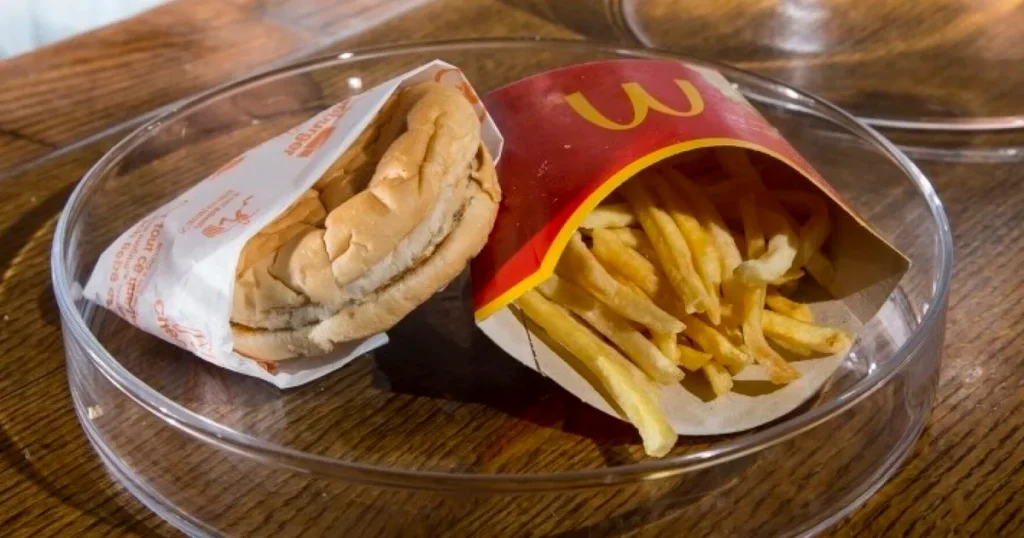
In an unusual twist, the last meal sold in the Reykjavík restaurant was kept as a souvenir and eventually put on display. But what exactly does it represent? Is it a statement on hyperprocessed foods and their unnatural ability to resist decomposition? A commentary on the cultural mentality of an isolated nation on the fringes of the modern world? Maybe it’s a rumination on both, or on something else altogether?
In this article, we consider the unusual story of McDonald’s in Iceland and ask the burning question on everybody’s mind: Just what exactly can we learn from that final cheeseburger sold in 2009?
McDonald’s in Iceland
McDonald’s first arrived in Iceland in 1993 in Reykjavík – 22 years after the first European restaurant opened in Zaandam in the Netherlands. For years, the brand was popular, especially with younger Icelanders and tourists, although it never expanded to more than three outlets in the capital. All three were all owned by the same franchisee, and they all shut their doors at the same time – at midnight on 31 October 2009.
The reason was the 2008 financial crisis. Iceland’s banking system collapsed dramatically, the Icelandic krona lost much of its value, and imported goods became far more expensive virtually overnight. Because the Icelandic operations relied heavily on imported ingredients and packaging from Europe, especially Germany, the cost of producing a burger reportedly doubled in a short time. Rather than raise prices, the decision was made to close all three stores.
The most famous part of the story is what happened on the final day: one man bought a cheeseburger and fries to keep as a souvenir instead of eating them. Amazingly, the burger became an internet curiosity because it barely appeared to decompose for years. It was eventually put on display and became a tourist attraction in its own right.
Why Did McDonald’s Never Return?
That the financial crisis killed off McDonald’s in Iceland may not be all that shocking – but what does surprise many is that in all the years to follow, the golden arches never returned. After all, Reykjavik is a modern, cosmopolitan capital with an international workforce, a strong digital sector, a booming tourism industry and a worldly, English-proficient populace. Why, then, does it lack many of the flagship chains that seem to sprout up organically in almost every modern city?
Instead, Iceland has a strong ecosystem of local and semi-local food brands that comfortably compete with international chains. Places like Tommi’s Burger Joint, Aktu Taktu, and the iconic Bæjarins Beztu Pylsur hot dog stand are not just alternatives – they are cultural institutions. These businesses are deeply embedded in everyday life, often with stronger identity and loyalty than any imported brand could easily replicate.
The pattern here reflects something distinctive about Icelandic – and more broadly Nordic – consumer culture. Nordic citizens are at once internationally-minded and keen to embrace the best of the modern world, yet they retain a strong sense of discernment and an appreciation for homegrown options rooted in local values and ingredients.
Take Sweden and Denmark, for example. These countries both have fewer McDonald’s restaurants per capita than their neighbours (4 and 5 stores per million people respectively, compared to 9 per million in the UK). At the same time, they are also home to successful local chains such as Max and Sunset Boulevard, which exist alongside their foreign rivals, providing consumers with choice and sending a clear message to the world – whoever you are, if you’re good, you’re more than welcome to join, but you won’t replace what’s already here.
The result is a more balanced, selective form of globalisation: international brands are present, but they are not culturally defining. Iceland simply pushes this logic further than anywhere else.
What Happened to the Last Burger?
Between 2009 and 2026, that final burger has been on quite a journey. After its purchase, it was initially kept privately by its owner before being donated to the National Museum of Iceland, where it was briefly exhibited as a kind of contemporary artefact. It later moved to a hostel in Reykjavík, before eventually being relocated to Snotra House in southern Iceland, where it remains on display to this day.
Perhaps the reason why that final burger resonates so strongly is because its story is a microcosm of the wider dynamics at play. Its preservation almost suggests it never truly belonged in the first place. The fact that it ever warranted collection in the first place marks it out as a relic from a brief experiment in global sameness, made notable precisely because it did not quite take root. It’s an object from a blip in time, and that sense of ‘outsider status’ is part of what gives it meaning.
There is also something striking about its durability in an Icelandic context. On an island shaped for centuries by harsh weather, isolation and scarcity, preservation has always been more than symbolic – it has been essential to survival. In that light, the idea of a hyperprocessed food product surviving so effortlessly feels unusually out of place – and somehow almost offensive, vulgar, or perhaps just unnatural.
Today, Iceland remains in the throes of rapid growth and urban development. It is clearly a modern country, open to the world and prepared to continue to welcome expats, foreigners, investments and innovations from all around the globe – both within the realms of food and in everything else.
However, it is also staunchly itself, and if this story tells us anything, it’s that this is unlikely to change any time soon. Much like that final burger encased behind glass, the Icelandic character has remarkable staying power – and this is something that anybody considering the Icelandic market should keep firmly in mind.
If you’re interested in doing business in Iceland, book a consultation to learn more about how we can help you. And be sure to also check out our Nordic Hub for more insights about Iceland and its neighbours in the region!