From cleaning up neighbourhoods to singing around Christmas trees, the Nordic countries have plenty of traditions that bring people together.
Some involve hard work, others are purely for enjoyment, and a few might seem rather unusual to outsiders. But they all reflect something deeply rooted in Nordic culture: a tradition of coming together, sharing responsibility and finding a sense of belonging through collective activities.
And naturally, the Nordic languages have developed some fascinating words to describe them.
In this post, we will explore six words from Denmark, Sweden, Norway, Finland and Iceland that offer a glimpse into the essence of Nordic community life.
1. Dugnad: The Norwegian Art of Pitching In
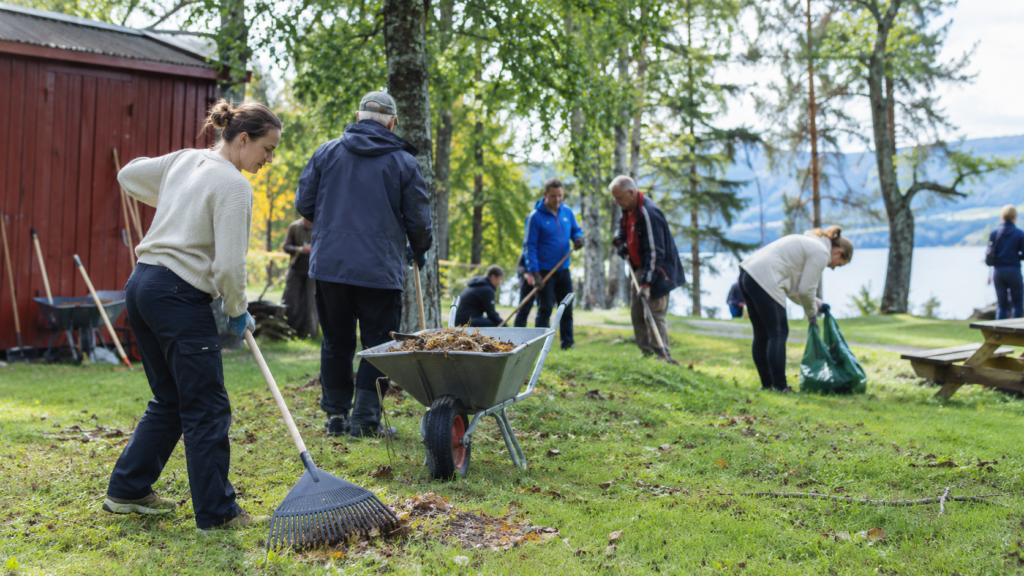
It’s Saturday morning in an Oslo suburb. The residents are gathering outside with rakes, paintbrushes and bin bags.
Welcome to dugnad.
The word refers to voluntary, unpaid work carried out for the benefit of a community. It comes from the Old Norse word dugnaðr, meaning ‘help’ or ‘support’, so the spirit of cooperation is built into the word itself.
A dugnad might involve cleaning a communal garden, repainting a sports clubhouse or preparing a playground for the summer. It’s a tradition that has deep roots in Norwegian society, and schools, sports clubs and housing associations all regularly organise these kinds of events.
There’s a slightly amusing contradiction at the heart of it all. While dugnad is technically voluntary, there’s often a strong social expectation that everyone will participate. After all, nobody wants to be the neighbour who enjoys the freshly painted fence without ever picking up a paintbrush.
And this is where things can get tricky for outsiders. An invitation to join a dugnad might sound entirely optional, but knowing how to read between the lines is important. Understanding these unspoken expectations is one of those cultural nuances that can take newcomers a while to navigate.
Fortunately, the work is often followed by coffee, waffles or a barbecue, giving everyone a chance to relax and get to know their neighbours.
2. Talkoot: Finland’s Tradition of Working Together
Norway isn’t alone in having a tradition of communal voluntary work. The Finns have talkoot, a remarkably similar concept, but with a rather interesting linguistic history.
Despite being firmly established in Finnish culture, the word actually comes from the Baltic languages. The Latvian and Lithuanian word talka has a similar meaning, and related words can also be found in Estonian and Finland-Swedish.
Historically, talkoot involved neighbours helping one another with demanding tasks such as harvesting crops, building houses or repairing roofs. Once the work was finished, the host traditionally provided food and drink, and sometimes there was even dancing.
Today, talkoot remains a familiar part of Finnish life, but the word has also found its way into the digital age.
In the 2010s, Finnish developed the verb talkoistaa, meaning to invite an open group of people to contribute unpaid work towards a particular task or problem – essentially, a form of crowdsourcing.
It’s a fascinating evolution: a tradition rooted in agricultural communities has given rise to a word describing how people collaborate in the modern world.
3. Fællessang: Nobody Needs to Be the Star
It’s not just work that brings Nordic people together. Communal singing is another much-loved tradition across the region, and in Denmark, it even has its own word: fællessang.
The word literally means ‘singing together’, and it’s closely connected to another important concept in Danish culture: fællesskab.
In Denmark, communal singing is a familiar part of life at schools, workplaces, sports clubs, birthdays and weddings. At some schools, pupils and teachers gather for a morning singalong, while at Christmas, families traditionally join hands, walk around the Christmas tree and sing together.
There’s even a famous songbook, Højskolesangbogen, which has helped keep the tradition alive for generations. First published in 1894, it’s one of Denmark’s bestselling books, and its latest edition contains 601 songs, ranging from traditional folk songs and hymns to contemporary music.
But what makes fællessang special is that nobody is expected to be a fantastic singer.
Compare it with karaoke, where one brave (or slightly tipsy) person takes the microphone while everyone else watches.
With fællessang, nobody gets the spotlight. Everyone joins in, and the shared experience matters far more than the quality of the singing.
And perhaps that’s what fællesskab is really about. It’s not simply being part of a group. It’s feeling that you belong to it.
4. Tipspromenad: Sweden’s Favourite Walking Quiz
The Swedes have found a rather charming way to combine fresh air, exercise and friendly competition.
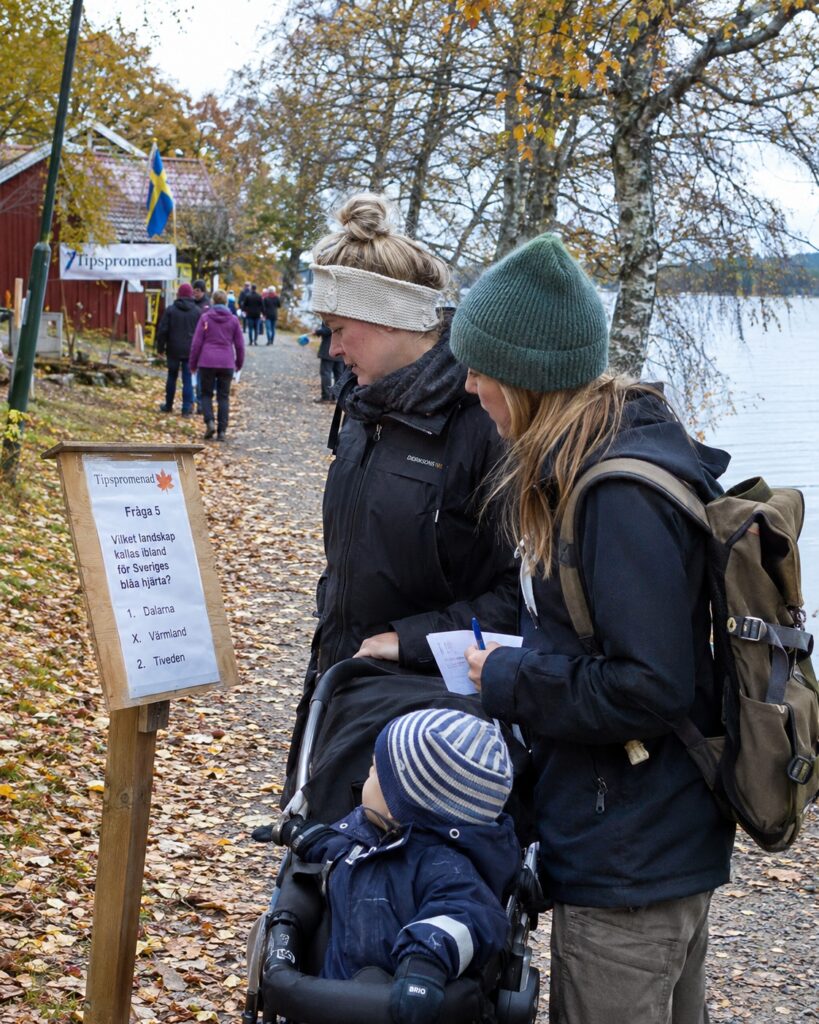
It’s called tipspromenad, which translates roughly as ‘quiz walk’.
The concept is simple. Questions are posted along a walking route, usually through a park, forest or neighbourhood. Participants follow the route, stopping to select an answer at each checkpoint.
Traditionally, there are three possible answers, marked 1, X and 2 – the same system used in Swedish football pools.
Tipspromenader are frequently organised by schools, sports clubs and local associations. Some communities hold them regularly, making them a familiar fixture of local life.
And because this is Sweden, there’s a good chance that fika will feature somewhere along the way. Once the quiz is over, participants might gather for coffee, cinnamon buns and a chat while the answers are checked.
It’s a wonderfully simple way to get people together. All you need is a pleasant walking route, a few questions and perhaps the satisfaction of knowing something your neighbour doesn’t.
5. Réttir: When Iceland Comes Together to Round Up Sheep
Every autumn, something rather extraordinary happens in the Icelandic countryside.
After spending the summer roaming freely across the mountains and highlands, thousands of sheep must be brought home before winter arrives.
And getting them back is no small undertaking.
Farmers, relatives and neighbours venture into the countryside, often on horseback or in off-road vehicles, to gather the animals. This stage, known as göngur, can take several days.
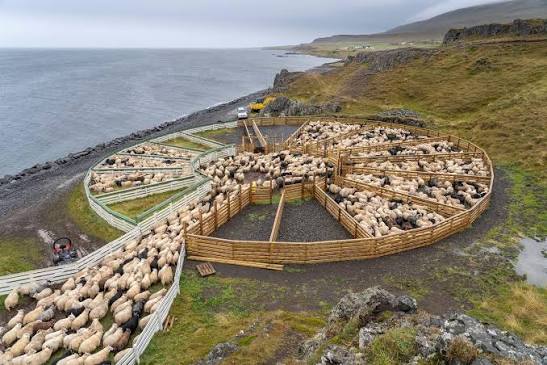
The sheep are then brought to communal sorting pens, where each farmer identifies and separates their own animals.
This part of the tradition is called réttir – a term that is also used for the annual sheep-roundup event as a whole.
And while the work is demanding, it’s also an important social occasion. Families gather to help, children get involved, and people who have moved away sometimes return to take part.
In some communities, the work is followed by food, music and dancing.
6. Breddekultur: Culture Is Something You Do
We’ll finish with a relatively new Danish word that’s attracting increasing attention.
Breddekultur takes its inspiration from breddeidræt, the Danish term for grassroots sport, where the emphasis is on participation and enjoyment rather than elite competition. Breddekultur applies that same thinking to cultural activities.
The idea is that culture isn’t just something we watch or consume. It’s something we actively do – whether that means singing in a choir, joining a pottery class or getting involved in amateur theatre.
The activities themselves are hardly new, but the concept is gaining recognition in discussions about Danish cultural policy.
As AI takes on more creative tasks, remote working becomes more common and more of our leisure time is spent in front of screens, opportunities to connect with others through shared cultural experiences may feel increasingly valuable.
That makes the growing interest in breddekultur feel particularly timely. Denmark already has a strong tradition of clubs and associations bringing people together around shared interests, but the concept encourages us to recognise the wider cultural and social value of these activities.
It’s a welcome shift in perspective. A weekly choir rehearsal or a local craft group isn’t simply a way to spend an evening. It’s also an opportunity to build relationships, exchange ideas and create something together.
And perhaps that’s the real appeal of breddekultur: it recognises ordinary people not just as consumers of culture, but as active contributors to it.
More Than Words: The Cultural Meaning of Community
From Norwegian dugnad to Icelandic réttir, these six words offer an interesting glimpse into the ways Nordic communities come together.
Of course, similar traditions exist all over the world. What’s fascinating is how particular words capture the customs, expectations and shared experiences associated with them.
You can translate dugnad as communal voluntary work, fællessang as communal singing and tipspromenad as quiz walk. But those translations don’t necessarily convey everything the words mean to the people who use them.
And that’s something we encounter regularly at Comunica.
Effective localisation involves more than finding equivalent words in another language. It also means understanding the cultural context behind those words, the people you’re communicating with and the unspoken meanings that can be so important in cross-cultural communication.
Discover More in Our Nordic Hub
Curious to learn more about the many different traditions, languages and cultural quirks that make the Nordic countries tick?
Explore our Nordic Hub for more insights into Nordic culture, communication and the fascinating differences between the region’s markets.