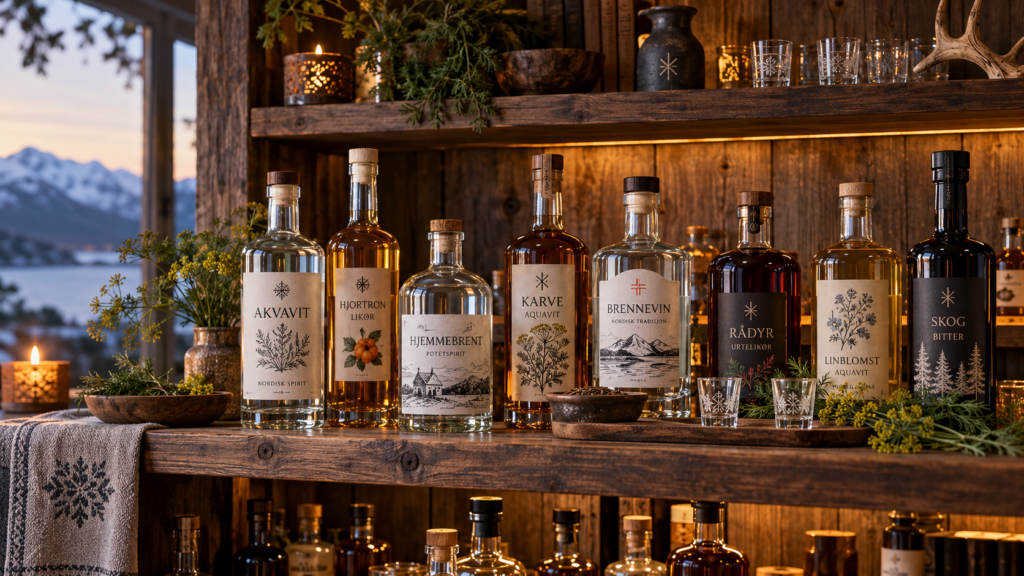
Every culture has its own drinking traditions, and the Nordic countries are certainly no exception. From homemade moonshine distilled on remote farms to carefully crafted spirits flavoured with local herbs and spices, the region has a long and colourful history of alcohol production.
Some of these traditions are familiar, like aquavit, the caraway-flavoured spirit enjoyed across Scandinavia. Others are rather more surprising. Think spirits made with secretions from beavers, bottles that travel halfway around the world before they’re ready to drink, and an Icelandic liquor whose label was deliberately designed to put customers off.
In this article, we’ll explore some of the Nordic region’s most interesting and unusual distilling and drinking traditions.
The Water of Life: Aquavit and Nordic Moonshine
One of the Nordic region’s best-known spirits is aquavit, or akvavit, a name derived from the Latin aqua vitae, meaning ‘water of life.’ That may sound like a rather grand name for such a strong alcoholic drink, but it makes more sense when you consider that distilled spirits were once widely regarded as medicine.
In fact, the earliest known written reference to aquavit in Norway dates back to 1531, when Danish nobleman Eske Bille sent a bottle to Olav Engelbrektsson, the Archbishop of Trondheim. In an accompanying letter, he enthusiastically recommended the drink as a remedy for a wide variety of internal illnesses. Unfortunately for the archbishop, aquavit’s medicinal reputation hasn’t exactly stood the test of time.
Over the following centuries, distilled spirits became an established part of Nordic life.
Aquavit developed into a distinctive drink, typically flavoured with caraway or dill, and sometimes accompanied by other botanicals such as fennel, anise or coriander. Different countries developed their own preferences. Norwegian aquavit, for example, is often aged in oak barrels, while the Swedish and Danish varieties are frequently lighter and clearer.
Alongside these established spirits, the Nordics also developed a thriving tradition of homemade alcohol. The names hjemmebrent (in Norway) and hembränt (in Sweden) literally mean ‘home-burned’ – a reference to the distillation process. These homemade spirits were particularly associated with rural communities, where families could produce alcohol using readily available ingredients such as grain or potatoes.
The authorities weren’t always quite as enthusiastic, however. In Norway, home distilling became widespread following legislation in 1816 that permitted many landowners and farmers to produce spirits. By 1833, the country had almost 10,000 registered distilleries. But concerns about excessive drinking eventually led to tighter restrictions, and by the middle of the century, most had disappeared.
That complicated relationship with alcohol continues today. Sweden, Norway, Finland and Iceland all operate state-controlled alcohol retail systems, designed to limit availability and reduce alcohol-related harm. Denmark is something of an exception, with a considerably more liberal approach to retail sales.
Beaver Shout: A Rather Unusual Secret Ingredient
If caraway and dill sound a little too ordinary, Sweden has another flavouring tradition that’s considerably more adventurous.
Meet Bäverhojt, a drinkable delicacy sometimes translated as ‘beaver shout.’
The drink is made by infusing alcohol with castoreum, known in Swedish as bävergäll. This is a strongly scented substance produced in special sacs near a beaver’s tail, which the animal uses to mark its territory.
Yes, really.
And while that might sound like an elaborate practical joke, castoreum actually has a surprisingly long history. It was once valued as a medicinal substance, used to treat everything from headaches to nervous complaints. It also found its way into perfumes and flavourings, thanks to its powerful, complex aroma.
In parts of Sweden, particularly within traditional hunting communities, castoreum was also used to flavour spirits. The resulting drink is sometimes described as having earthy, musky and leathery notes, which probably gives you some idea as to why it hasn’t become an international bestseller to rival the likes of gin or rum.
It’s certainly an acquired taste, but Bäverhojt is a fascinating example of how local traditions can develop around ingredients that might seem completely unappealing elsewhere.
And if you’re wondering whether this is still a thing, the answer is yes. Although decidedly niche, beaver-flavoured snaps remains part of certain Swedish hunting and drinking traditions.
Linie Aquavit: The Spirit That Crosses the Equator Twice
Most spirits spend their ageing process sitting quietly in a cellar or warehouse. One Norwegian aquavit, however, prefers to travel.
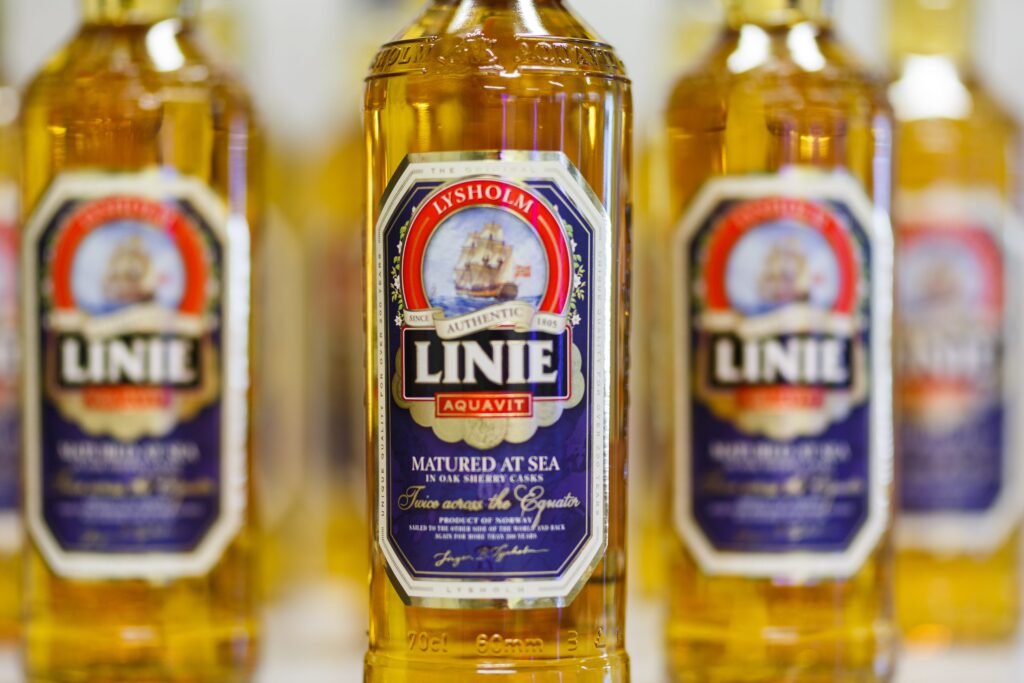
Linie Aquavit has an extraordinary production tradition: every batch is sent on a sea voyage that crosses the equator not once, but twice.
The story begins in 1805, when the Norwegian Lysholm trading family shipped a consignment of aquavit to the East Indies, hoping to find customers for their product. Unfortunately, the venture wasn’t successful, and the unsold barrels eventually made their way back to Norway.
But when the aquavit returned, something unexpected had happened. The long journey had transformed the drink, leaving it smoother and more rounded than before.
The producers realised that the constant movement of the ship, combined with changes in temperature and humidity, had influenced how the spirit matured inside its wooden barrels.
Rather than dismissing the voyage as an unsuccessful business venture, they turned it into a defining feature of the product.
More than two centuries later, Linie Aquavit continues to mature at sea. Its barrels, previously used for ageing sherry, spend around four months aboard cargo ships, travelling through different climate zones and crossing the equator twice before returning to Norway.
The spirit takes its name from this journey: Linie refers to the equator, traditionally known simply as ‘the line.’
And here’s another lovely detail: each bottle carries a lot number that allows customers to trace the maritime journey their aquavit has taken.
This is a wonderful example of how a commercial failure, an accidental discovery and a bit of Norwegian ingenuity combined to create a tradition that has survived for generations.
Brennivín: The Icelandic Spirit Nobody Was Supposed to Want
When businesses design packaging, they generally want their products to look as attractive as possible. Iceland once took a rather different approach.
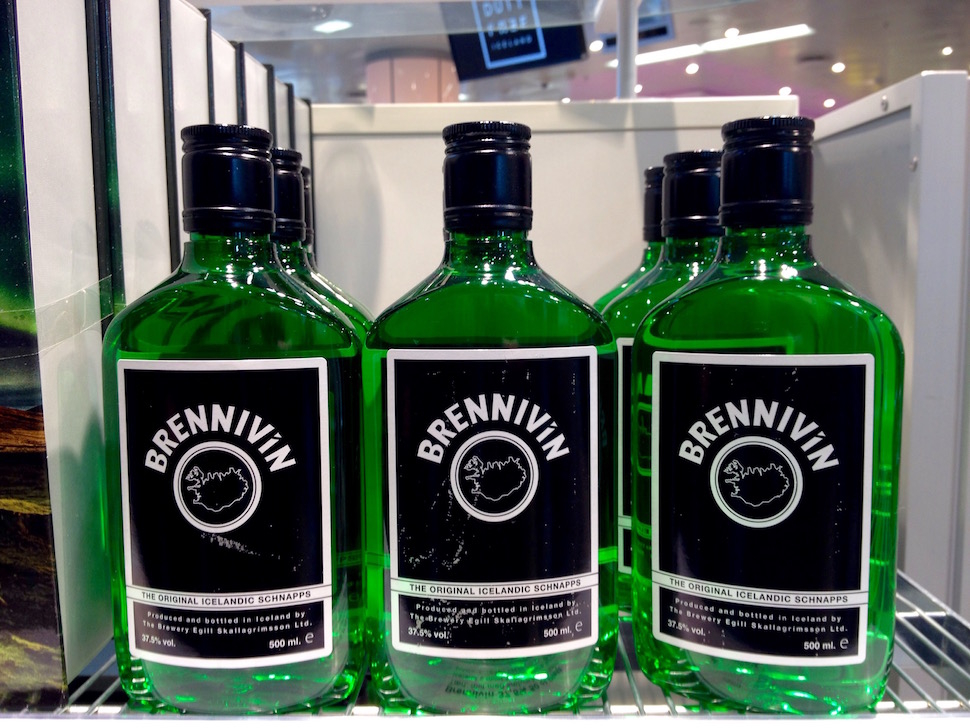
In 1935, following the partial repeal of prohibition, Iceland introduced Brennivín, a traditional spirit flavoured with caraway. Its name literally means ‘burning wine,’ although the drink is generally made from a neutral spirit rather than wine.
What makes Brennivín particularly interesting isn’t just the drink itself, but its packaging.
The authorities were concerned about encouraging excessive alcohol consumption, so they chose a stark black label intended to make the bottle look as unappealing as possible.
The thinking was simple: if the product looked unattractive, perhaps fewer people would buy it.
Unfortunately for the authorities, this strategy backfired spectacularly.
Rather than putting consumers off, the distinctive design helped make Brennivín one of Iceland’s most recognisable spirits. Its rather ominous appearance also contributed to its nickname, Svarti dauði, or ‘black death.’
Today, Brennivín is firmly established as part of Icelandic food and drink culture, particularly during traditional celebrations such as Þorrablót, when it is often served alongside local delicacies.
Snapsvisor: When Drinking Becomes a Singalong
Of course, Nordic drinking traditions aren’t just about what’s in the glass. Sometimes, what happens before you drink is just as important.
In Sweden, for example, there’s a long-standing tradition of snapsvisor, or drinking songs, performed before raising a glass of snaps.
These short, usually humorous songs are particularly associated with celebrations such as Midsummer, Christmas and traditional crayfish parties. They’re often sung to familiar melodies, making it easy for everyone around the table to join in, regardless of their musical talents.
The best-known example is Helan går, a song that has been performed at countless Swedish celebrations for well over a century. Its title refers to helan, traditionally the first drink in a sequence of snaps.
The lyrics jokingly suggest that anyone who doesn’t drink the first glass won’t be allowed the next one either.
The scale of this phenomenon is not to be minimised: Stockholm’s Museum of Spirits has collected more than 12,000 snapsvisor from around the country and throughout the ages. The tradition even made an unlikely appearance at the 1957 Ice Hockey World Championship in Moscow, when the victorious Swedish team reportedly sang Helan går instead of their national anthem, because not everyone knew the words.
Although the tradition developed largely in student and middle-class circles during the 19th century, it’s still very much alive today. New lyrics continue to be written, often adapting familiar tunes to contemporary events and popular culture.
More than Just a Drink
From Iceland’s deliberately unappealing bottles to Norway’s globe-trotting aquavit and Sweden’s rather unexpected use of beaver secretions, Nordic spirits have some remarkable stories to tell.
But they’re about more than unusual ingredients and entertaining anecdotes. They reveal how geography, history, language and social customs shape the traditions we associate with different countries.
Even the words themselves tell part of the story. Whether it’s the Latin-inspired aquavit, the wonderfully literal hjemmebrent, or the distinctly Swedish snapsvisa, each expression carries cultural meaning that goes beyond its dictionary definition.
At Comunica, understanding these linguistic and cultural nuances is central to what we do. Because communicating effectively across markets isn’t just about translating words. It’s about understanding the traditions, references and associations that make them meaningful to local audiences.
Curious to discover more about the languages, cultures and traditions of the Nordic region? Explore our Nordic Hub for more insights.